

Gridlines: Making expert knowledge accessible without the expert
When the answers already exist but everyone still needs to ask the expert, the problem isn't a lack of knowledge. It's access to it.
Gridlines
Challenge
Students repeatedly turned to founder Kenny for help with financial modelling questions, despite having access to extensive training materials. Providing individual answers took time away from other work and made students dependent on his availability.
What we did
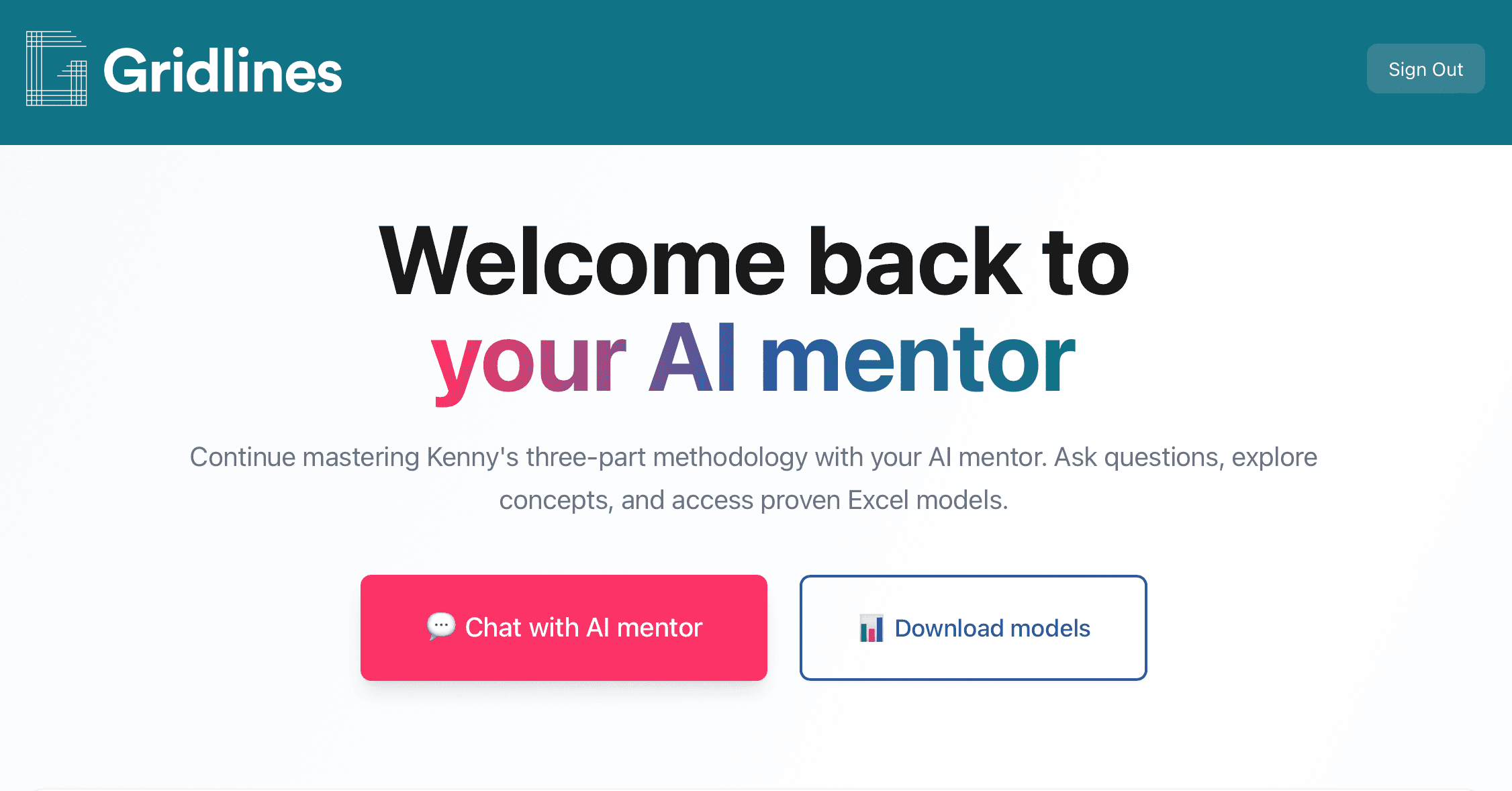
Built a structured knowledge system and AI mentor that helps students find relevant explanations, understand financial modelling concepts and access supporting Excel models.
Outcome
On-demand access to Gridlines' specialist knowledge, designed to reduce repeated questions and allow Kenny to support more students without personally answering every query.
The broader pattern this reveals
In many specialist businesses, valuable knowledge is concentrated in a small number of experienced people.
They create guides, write documentation and train colleagues or customers. Yet the same questions keep coming back.
People may know the answer exists somewhere, but finding it takes longer than asking the expert.
The result is a familiar pattern: experienced people are interrupted, others wait for answers, and the business struggles to make its expertise available more widely.
Documenting knowledge doesn't automatically make it accessible.
Why a better handbook wasn't the answer
Gridlines provides specialist financial modelling training, led by founder Kenny.
Kenny had already invested considerable effort in documenting his expertise, producing a handbook of approximately 400 pages alongside a library of 85 Excel models.
The material was detailed and comprehensive. The problem wasn't that students lacked resources.
It was that financial modelling questions rarely fit neatly into a single chapter.
A student struggling with a formula might need to understand an underlying modelling principle, find a worked example and locate the right Excel model.
Traditional document searches could find matching words, but not necessarily the explanation that would resolve the student's confusion.
The obvious response might have been to reorganise the handbook or add more FAQs.
But creating more material wouldn't necessarily help students find and apply the knowledge already available.
We needed to change how students accessed Kenny's expertise, not ask him to document it again.
The real problem
Answers were difficult to locate
Relevant guidance could be spread across different chapters, examples and supporting materials.
Questions required context
A useful answer often depended on connecting several financial modelling concepts, rather than retrieving a paragraph containing the right keywords.
Teaching style mattered
Kenny's explanations reflected years of experience helping students understand complex subjects. A generic AI response could lose that clarity and approach.
The expert remained the fallback
When students couldn't find or understand the material, asking Kenny was often the quickest option, creating repeated interruptions and dependency.
The challenge was to make the existing knowledge work more like an accessible teaching resource.
How we approached it
We focused first on understanding and structuring the knowledge, then on how AI could help students use it.
1. Mapped the knowledge and its connections
We examined the handbook's structure, including chapters, terminology, worked examples and relationships between topics.
The aim was to understand how someone learns financial modelling, not simply how the document is organised.
That helped us identify the context needed to answer questions accurately.
2. Built a structured knowledge system
Rather than uploading the handbook into a generic chatbot, we designed a system to retrieve relevant material while preserving its source and context.
This allows answers to draw on the appropriate sections of the handbook and helps students trace explanations back to the original teaching material.
3. Created an AI mentor around Kenny's approach
We developed an AI mentor designed to explain concepts in a way that reflects Kenny's teaching style.
It can respond to questions, clarify terminology and guide students through problems using the Gridlines material.
Crucially, answers are grounded in the handbook, with references to the relevant source sections.
The objective isn't to replace Kenny's expertise with generic AI-generated advice. It's to make his existing explanations available when students need them.
4. Connected the supporting Excel models
We also organised Gridlines' library of 85 Excel models into a searchable resource.
Students can find models by relevant topic, chapter or type of example, and connect them with the supporting explanations.
This brings the practical resources into the learning experience rather than leaving them as a separate collection of files.
What it looks like in practice
From a student question to a useful explanation
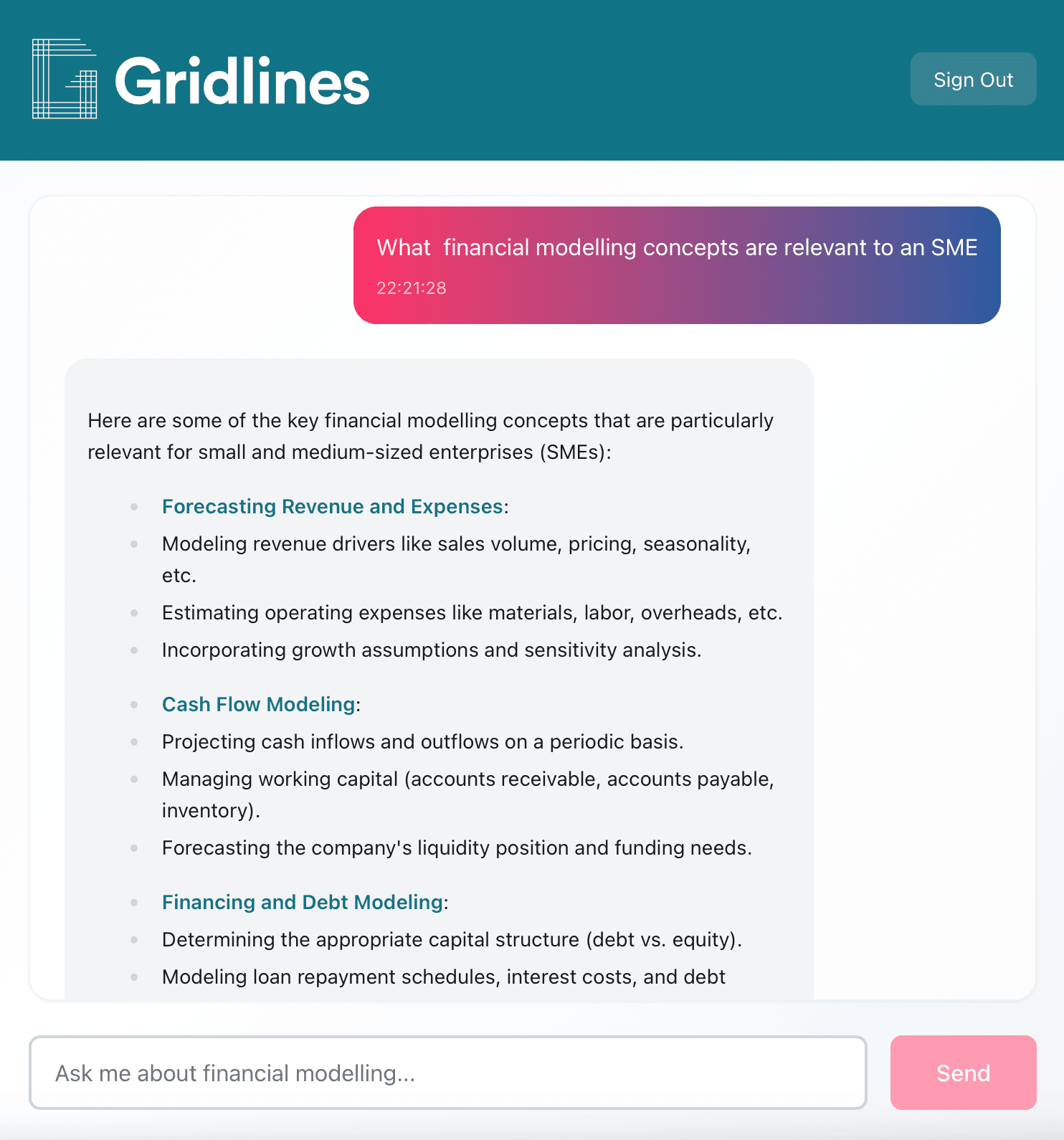
A student is struggling to understand how a financial modelling formula works.
Previously, they might search the handbook, try to locate a relevant example and eventually ask Kenny.
Now they can ask the AI mentor in their own words.
The mentor identifies relevant handbook material and provides an explanation in Kenny's teaching style, with references students can use to explore the subject further.
If the question connects several concepts, the response can bring those explanations together.
From a concept to the right Excel model
A student wants to practise a particular modelling technique.
Instead of searching through a collection of files, they can browse or search the organised model library.
Relevant Excel models are easier to locate, alongside the chapters and explanations that support them.
The student can move from understanding the principle to working through a practical example.
What changed
Specialist knowledge available on demand
Students can ask questions and receive explanations grounded in Gridlines' existing training material.
85 Excel models organised for easier access
Supporting resources can be found and connected to relevant topics and explanations.
Less dependence on the founder's availability
The system is designed to resolve more routine questions without requiring Kenny to respond personally.
The knowledge system and resource library have been developed. Reductions in interruptions and support workload have not been quantified.
Why this worked
The obvious problem appeared to be the number of questions Kenny received.
But simply adding a chatbot wouldn't have solved the difficulty students faced finding accurate, relevant explanations.
The important work was understanding how the knowledge was structured, how different concepts connected and what made Kenny's teaching useful.
That gave AI a reliable foundation for helping students find and apply the right information.
The result is more than a searchable document. It's a way of making existing expertise easier to use.
What this proves
The value of AI isn't always in creating new knowledge. Sometimes it's in making the expertise a business already has available to more people, without depending on the expert being there.
Facing a similar challenge?
If customers or colleagues repeatedly ask the same questions, even though the answers exist in documents, training materials or experienced people's heads, your business may have a knowledge-access problem.
At The Foundry, we help businesses organise their expertise and build practical AI systems that make it easier to find and use.
Let's talk about making your business's knowledge more accessible.