

End2End Accounting: Taking the pressure out of Spain's tax deadlines
Spain's quarterly tax deadlines create an unavoidable rush of administration. The Foundry identified an opportunity to reduce the repetitive work behind those deadlines while preserving accuracy and control.
End2End Accounting
Challenge
Hundreds of clients face the same quarterly tax deadlines, with staff manually transferring invoice information into the firm's accounting software.
What we proposed
AI-powered invoice capture, structured preparation for A3 and team-led review and approval.
Intended outcome
Less repetitive administration, reduced pressure during filing periods and greater capacity to grow without proportionally increasing headcount.
The broader pattern this reveals
For many professional services businesses, growth creates more administration. But when work arrives in concentrated peaks, adding permanent staff isn't necessarily an efficient answer.
In Spain, quarterly tax deadlines fall on the same dates across End2End's client base. Hundreds of clients' invoices need processing within the same limited window.
The practice needs sufficient capacity for these peaks, even though the same workload doesn't exist throughout the year.
The bottleneck isn't just the volume of work. It's how much has to happen at once.
Why entering invoices faster wasn't the answer
End2End provides accounting and advisory services to international clients operating in Spain.
Clients upload invoices into shared Google Drive or Dropbox folders. End2End's team opens each document and manually enters supplier details, dates, invoice numbers, amounts and tax information into A3.
Multiply this across hundreds of clients and numerous invoices, and the administrative burden becomes substantial.
The obvious response might be to find ways for staff to enter information faster.
But we challenged that assumption.
Why ask people to retype information that already exists in the invoices?
The opportunity was to remove the manual entry, not simply speed it up.
The real problem
Information was already available
Invoices contained most of the required details, but extracting them involved repetitive manual work.
Deadlines concentrated the workload
Every client faced the same quarterly filing dates, creating predictable administrative peaks.
Growth increased the pressure
Each additional client meant more invoices to process within the same reporting window.
Accuracy remained essential
Staff still needed to verify information and resolve exceptions before it entered the accounts.
The challenge was to remove unnecessary work while preserving important checks.
How we approached it
We examined where staff time was going and which activities genuinely required human involvement.
1. Identified the work that didn't need a person
Most of the information staff were typing already existed in the original documents.
We proposed using AI to extract it automatically, changing the team's role from entering every invoice to reviewing prepared information.
2. Worked with existing client behaviour
Clients would continue uploading invoices into their usual Google Drive or Dropbox folders.
The proposed system would collect those documents, extract supplier details, dates, invoice numbers, net amounts, IVA and totals, and organise everything into a consistent structure.
Clients wouldn't need to adopt a new process.
3. Designed around review, not blind automation
This was the critical design decision.
For each client and accounting period, staff would see which invoices had been collected, processed or flagged for attention.
They could inspect original documents alongside extracted information, correct errors and approve the results.
Only reviewed and approved information would move forward.
The aim was to replace repetitive typing with informed checking, not remove human responsibility.
4. Connected the existing accounting workflow
Approved information would be prepared for import into A3, potentially through End2End's existing Quipu route.
We separated extraction, review, approval and import into distinct stages so the team could see what had happened and what needed attention.
This preserved the accounting workflow while changing how information was prepared for it.
What it could look like in practice
From a folder of invoices to structured information
An illustrative client, Harbour Studio SL, uploads 24 invoices into its usual Google Drive folder.
The proposed system collects the documents and extracts the accounting information. Twenty-two are processed successfully, while two are flagged for checking.
The team can see the batch's status without opening every invoice to begin entering data.
From typing to checking
A team member opens Harbour Studio's invoice review screen.
A table displays each supplier, invoice number, date, net amount, IVA and total. Selecting an entry shows the original invoice alongside the extracted details.
The reviewer checks the information, resolves exceptions and approves the data for preparation for A3.
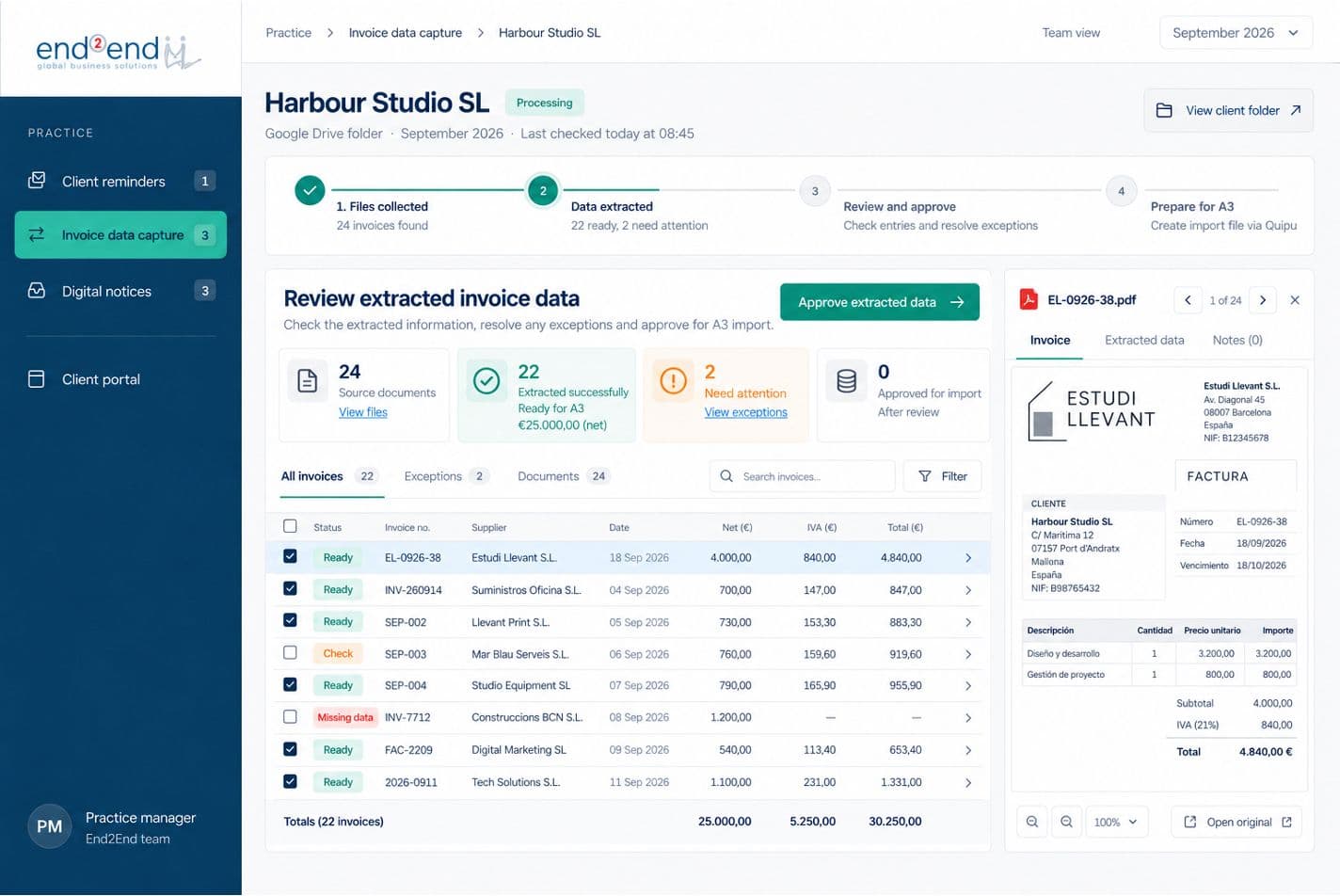
Illustrative view of the proposed invoice capture and review workflow.
What we aim to change
Less repetitive administration
Invoice information captured and structured automatically rather than retyped.
More time for valuable work
Staff focused on checking accuracy, resolving exceptions and supporting clients.
Greater capacity during reporting peaks
Less administrative effort per client, creating the potential to handle growth without equivalent increases in staffing.
This remains a proposed solution. Implementation and measurable outcomes have not yet been established.
Why this approach makes sense
The obvious answer to overwhelming quarterly deadlines might be more people.
But that doesn't address the fundamental inefficiency: repeatedly entering information that already exists in client documents.
The Foundry's approach separates repetitive administration from the checking and judgement that still require people.
Automate the first. Preserve the second.
What this proves
When every client faces the same deadline, reducing the manual work required per client can change the economics of growth.
AI's value isn't necessarily in replacing professional expertise. It can be in removing the repetitive work that prevents people from using that expertise effectively.
Facing a similar challenge?
If your business faces recurring administrative peaks, manual data entry or a workload that grows with every new client, the answer may not be more people.
At The Foundry, we identify where work gets stuck and design practical AI solutions around how businesses actually operate.
Let's talk about what's limiting your capacity.